How Wapello County started a veterans food bank
By LISA ROSSI
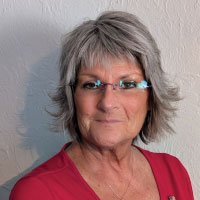
Deb Fenton-Roe
On the latest episode of the Iowa Stops Hunger Podcast, host Michael Morain, editor of dsm magazine, interviewed Deb Fenton-Roe, commissioner of Wapello County Veterans Affairs, on the county’s efforts to help veterans facing food insecurity. The following are five takeaways from the conversation.
1. Helping veterans in Wapello County meant finding the right space.
“Almost four years ago, we were an outdoor distribution, and we were located behind the mall in Ottumwa, and it was still a mobile distribution, so the veterans and/or spouses of lost veterans never had to leave their car — and we did that for several months — and we were out in the elements. We did it all,” Fenton-Roe said. “Then we realized, winter is coming on, where this is not going to be feasible for our volunteers.”
But then they got a suggestion to use a nearby emergency management building as a drive-thru and got the OK to move their operation.
“So now we have [them] come [in]the car, and we have two stations … and then they drive right on into the building. We have the setup. There’s usually three to four stops with all of the different food items. The veteran and/or spouse never gets out of the car. Our volunteers load everything into the car for them. Then when they’re finished loading, there’s another overhead door, and they can just drive right on back out again. It’s pretty slick. We are so thankful for having that building.”
The county distributes food on the first Thursday of the month from 4 to 6 p.m.
2. The operation has expanded beyond Wapello County.
“In December, we served 250 [people], and that includes veterans or spouses of deceased veterans. We greatly appreciate [spouses] coming through too and try to get the word out that they’re eligible as well,” she said.
For the four years of the effort, the Food Bank of Iowa has supplied the food each month.
“They approached the commission about four years ago and said, ‘Hey, we have an entity that would like to set up a distribution for veterans in Wapello County. That entity happens to be the Ottumwa Legacy Group.’ They, for all four years now, have given the money solely to Veterans of Wapello County, Food Bank of Iowa to be supported here.
“It started as Wapello County, but then we had some veterans that were driving in from all surrounding counties. We have people that come in from Mount Pleasant, Sigourney, Centerville, and we thought, ‘This is great, because … we want to be able to serve any veteran or spouse that can make it there for the drive-thru, and serve them everything that we can. … We have names of veterans that are either homebound or have no vehicle and no way to have transportation to go through the distribution line, so we home-deliver to them.”
3. Setting up a program from scratch is an involved process, including securing donors and partners.
“Not long ago, I had a gentleman call me [who] lives in the Iowa City/Cedar Rapids area, and he said he was originally from Ottumwa, but he had moved into that area, and he called and he said, ‘Hey, I want to pick your brain. How can we get one of these started up here? Because there’s a lot of veterans around there as well that are in need.’ The first hurdle is somebody has to pay for the food, because they need to be a donor. It comes from Food Bank of Iowa, through the USDA — they reach out and do their own ordering. They get a nice break on the cost of different things.
The items that we distribute monthly are always changing. It’s not the same thing. There’s a dry box, and in that has a little bit of the five basic food groups. And then we have other items that will be added on. There’ll be fresh fruit or a fresh vegetable of some kind. There will also be a frozen meat of some kind. This gentleman and I talked a lot about that and how the process works. … He said at the end of our conversation, ‘Wow, that’s a lot of work.’ I said ‘It is a lot of work, but it’s more than worth it.’”
4. Having a veterans food bank means overcoming attitudes that ‘we fend for ourselves.’
“We were taught when we were serving in the military that we fend for ourselves. We make whatever we have work. I was not very surprised, I’ll put it that way, because it’s a typical veteran attitude of us inviting people, ‘Please come through the distribution, this is a wonderful service,’ and the veteran saying, ‘No, it’s OK. I’m all right. Just save it for somebody else that needs it worse than me.’ … I wish we [weren’t] ingrained with that attitude – learn to take care of yourself. But I am surprised how we grew over these almost four years. That very first distribution, throughout that summer we served 60, which we were quite pleased with. And now, [in] December, we served 250 and we do all of that in two hours.”
5. Organizers aim to share the message: ‘It doesn’t matter what category you think you’re in financially, we’re here to help you.’
“I would invite any veteran, any spouse of a deceased veteran, to come. All we need to do is prove that you are a veteran. We do require that as our distribution line starts in the registration. We do require proof of [being a] veteran. I would encourage every one of them to come out, and partake in our camaraderie, because, as every veteran drives through, they’re more than appreciative. Some days we’re out there and it’s 95 degrees and it’s hot, and in December, we were all bundled up, and we actually had to modify it a little bit because that was the night that it was zero [degrees]. We modified the distribution where those of us doing the registration were standing right inside the building, so we’re trying to protect our volunteers. I would invite anyone, it doesn’t matter what category you think that you’re in financially or not, we’re here to help you.”
To learn more, visit the Veterans of Wapello County Facebook page.